
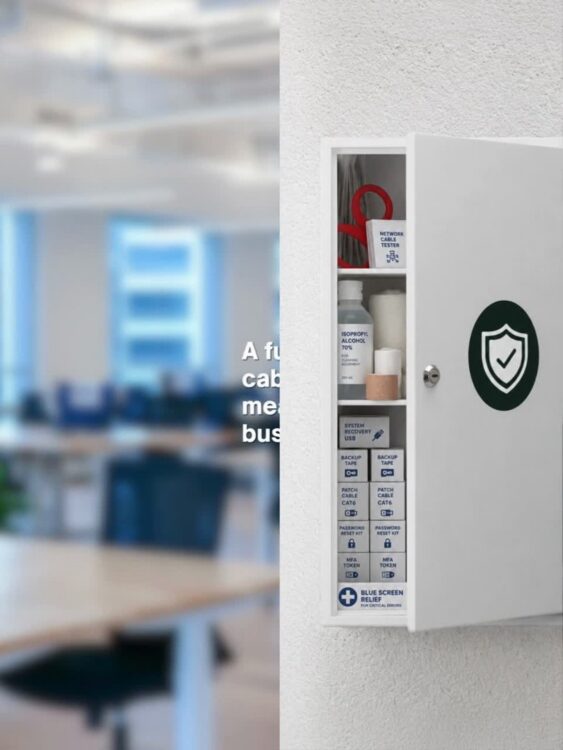
October is Cybersecurity Awareness Month, making it a great time for Billings small business owners and nonprofit leaders to take a closer look at how well their organizations are protected.
Think about your medicine cabinet at home.
Over time, you collect cold medicine, vitamins, allergy medications, and prescriptions. Before long, the cabinet is full.
However, having a cabinet full of medicine doesn’t necessarily mean you’re healthier.
Your business cybersecurity can work the same way.
For small businesses and nonprofits in Billings, MT, with 5 to 50 employees, it’s easy to accumulate cybersecurity products over the years.
You purchase antivirus software. Then you add email protection. Your insurance company requires additional safeguards. A vendor recommends another security product. Eventually, you’re paying for several tools, but you’re not entirely sure what each one does—or whether they’re all working together.
Unfortunately, more cybersecurity tools don’t automatically mean better protection.
What matters is having the right protections, properly managed, working together to protect your organization.
Cybersecurity Myth: More Security Tools Mean Better Protection
It’s a common assumption.
If one cybersecurity product helps protect your business, adding another should make it even safer.
However, cybersecurity isn’t quite that simple.
Multiple layers of security can be valuable. In fact, a layered approach is often important for protecting business systems and sensitive information.
The problem starts when organizations add products without understanding how everything fits together.
For example, your business might have multiple security tools that perform similar functions while still lacking important protections elsewhere.
Or perhaps you’re paying for monitoring software, but nobody is consistently reviewing the alerts.
As a result, you may be spending money on cybersecurity without knowing whether your organization is adequately protected.
The goal isn’t to have the most security products. It’s to have the right protections working together.
Healthy Cybersecurity Works Like an Immune System
Your body’s immune system doesn’t rely on one solution to keep you healthy.
Instead, different parts work together to recognize threats, respond to problems, and help protect you.
Your business cybersecurity should follow a similar approach.
For example, a coordinated cybersecurity strategy may include:
- Endpoint protection: Helping protect employee computers and devices from malicious software.
- Email security: Filtering suspicious messages and phishing attempts.
- Multi-factor authentication (MFA): Adding another layer of protection to employee accounts.
- Data backup and recovery: Helping restore important business information after an incident.
- Security monitoring: Identifying suspicious activity and potential problems.
- Employee cybersecurity training: Teaching employees how to recognize and report threats.
- Incident response planning: Establishing what happens when a security issue occurs.
Each protection serves a purpose.
However, these safeguards are most effective when they’re properly configured, monitored, maintained, and coordinated.
For a Billings accounting firm, professional services company, contractor, or nonprofit, the right cybersecurity strategy should reflect the information you handle and the systems your employees depend on.
Cybersecurity should fit your organization—not the other way around.
Give Your Business Cybersecurity a Checkup
You don’t need to become a cybersecurity expert to ask the right questions.
However, as a business owner or nonprofit leader, you should understand whether your organization’s security is being actively managed.
Here are four questions worth discussing with your IT provider.
1. What Cybersecurity Tools Are We Using, and Why?
Start with the basics.
Do you know what security protections your organization currently has?
More importantly, do you understand what they’re supposed to protect?
For example, you might be paying for antivirus, email filtering, cloud security, backup services, and network protection.
That’s not necessarily a problem.
However, someone should be able to explain what each major protection does, why it’s needed, and how it supports your overall cybersecurity strategy.
If nobody can explain what you’re paying for, it’s time to take a closer look.
2. Are We Paying for Overlapping Tools While Missing Important Protections?
Some overlap in cybersecurity is intentional and beneficial.
For example, having multiple layers of protection can help reduce risk if one safeguard fails.
However, unnecessary duplication can also create complexity and additional expense.
For a small business or nonprofit with 5 to 50 employees, every technology investment should have a purpose.
Ask your IT provider whether your existing tools complement one another or whether some are duplicating the same functions.
At the same time, look for potential gaps.
Perhaps your computers are protected, but your employees haven’t received cybersecurity awareness training.
Or maybe your organization has backups, but nobody has tested whether your data can actually be restored.
The important question isn’t how many protections you have. It’s whether the protections address your actual risks.
3. Who Is Making Sure Our Cybersecurity Is Working?
This is one of the most important questions a business owner can ask.
Having cybersecurity software installed is only part of the equation.
Someone also needs to make sure it’s functioning properly.
For example, what happens when a security tool generates an alert?
Does someone investigate it?
What happens if a backup fails?
Who notices when an employee’s computer stops receiving important security updates?
Without clear responsibility, important warnings can go unnoticed.
That’s why proactive monitoring and ongoing cybersecurity management matter.
You shouldn’t have to wonder whether someone is paying attention to your organization’s security.
4. When Did We Last Review Our Cybersecurity Needs?
Your organization probably looks different today than it did three years ago.
Maybe you’ve hired more employees, moved offices, adopted cloud software, or started allowing employees to work remotely.
Perhaps your nonprofit has expanded its programs, added staff, or introduced new donor management software.
As your organization changes, your cybersecurity needs change too.
Unfortunately, many small businesses continue using the same security setup year after year without reviewing whether it still makes sense.
Instead, make cybersecurity reviews part of your regular technology planning.
That way, your protections can evolve alongside your business rather than falling behind.
Why This Matters for Billings Small Businesses and Nonprofits
For organizations with 5 to 50 employees, technology needs to be reliable without becoming another full-time responsibility for the owner or executive director.
Your employees need access to email, files, customer information, accounting software, and other systems to do their jobs.
Meanwhile, nonprofit organizations may also depend on donor databases, grant records, volunteer information, and program management systems.
A cybersecurity incident can interrupt those operations, regardless of your organization’s size.
And while larger companies may have dedicated cybersecurity departments, smaller organizations often depend on an outside IT provider to manage those responsibilities.
That’s why having the right technology partner matters.
You need someone who understands your systems, monitors your protections, identifies potential risks, and helps you make informed decisions about cybersecurity investments.
Most importantly, you need a partner who can explain what matters without overwhelming you with technical jargon.
Stop Collecting Cybersecurity Tools. Start Building a Strategy.
Think back to that medicine cabinet.
Adding another bottle doesn’t necessarily improve your health.
Likewise, purchasing another cybersecurity product doesn’t automatically make your organization safer.
Instead, focus on building a coordinated approach that includes the right tools, ongoing monitoring, employee awareness, and clear responsibilities.
At NextX, we help small businesses and nonprofits throughout Billings and Yellowstone County take the guesswork out of cybersecurity.
We work with organizations to understand their existing technology, identify potential security gaps, evaluate protections, and develop practical strategies that support daily operations.
Our goal isn’t to make cybersecurity more complicated.
It’s to help you understand what’s protecting your organization, who’s managing it, and where improvements may be needed.
Is Your Cybersecurity Actually Working Together?
If you’re unsure which security products your organization uses, whether they’re properly managed, or where potential gaps might exist, now is a good time to find out.
You don’t need another technology headache.
You need a clear understanding of where your organization stands.
Schedule a 10-minute discovery call with NextX to discuss your current cybersecurity approach and identify opportunities for improvement.
Call 406-671-7171 or visit nextx.net.
NextX — Your Managed Technology Partner.
Free IT Consultation | NextX Communications, Inc. | Billings, MT